
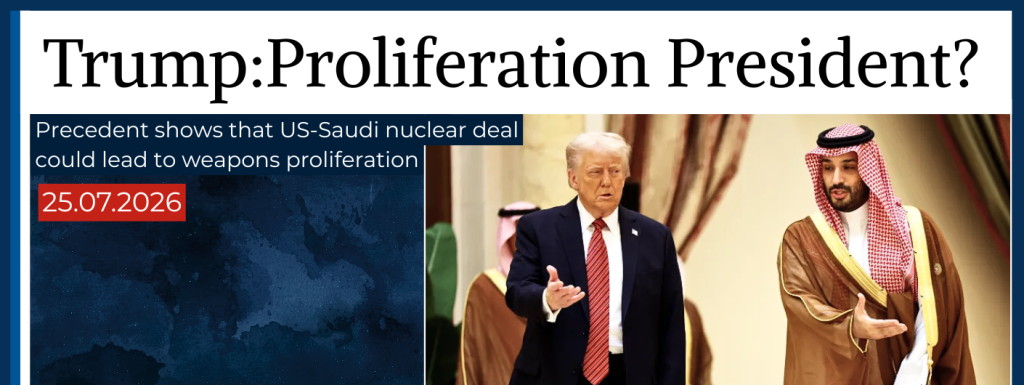
The second Trump administration has already done much to undermine the nuclear non-proliferation regime. In particular, military attacks on Iran during nuclear negotiations – ostensibly to enforce ‘non-proliferation’ – has arguably weakened these international norms considerably.
In quite a turn on Trump’s supposed commitment to non-proliferation in the Middle-East, this week a deal was signed between Washington and Riyadh in which the US would provide the materials and expertise to kickstart Saudi-Arabia’s nuclear energy programme.
Concerningly, the deal included openness to Saudi Arabia pursuing domestic uranium enrichment (as opposed to importing imported uranium), and proposed that US oversight would ensure the Saudi nuclear programme was not weaponised, instead of the International Atomic Energy Agency (IAEA).
For Washington, the benefit is to the US companies paid to set up the Saudi nuclear programme, and also crowding out the geopolitical competition from China, Russia and Pakistan over Saudi Arabia.
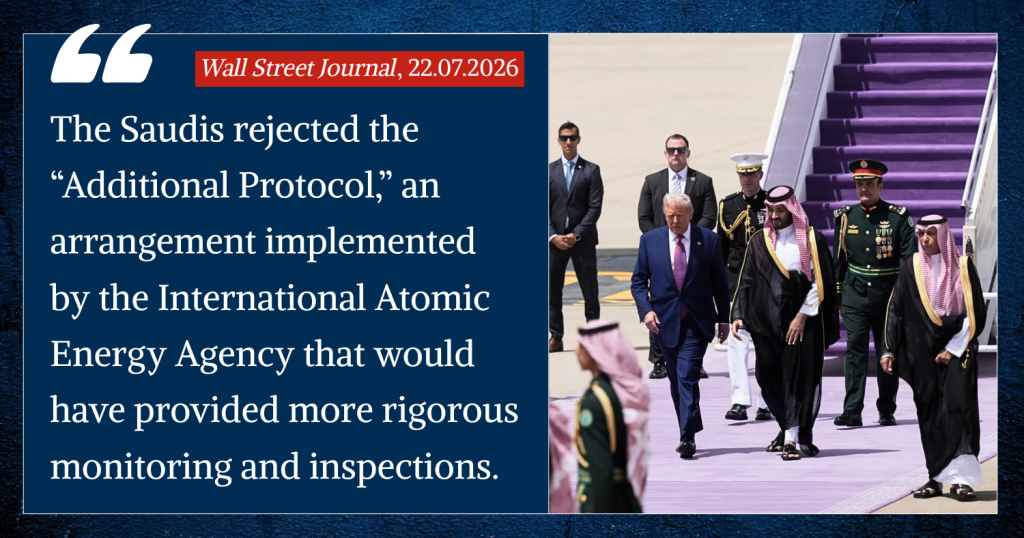
But a social media post by Trump on Thursday suggested any deal was conditional on Saudi Arabia joining the Abraham Accords and normalising relations with Israel, re-instating a condition previously set by the Biden administration. Trump’s statement has caused some uncertainty about the status of the new nuclear deal, which has reportedly already been signed.
This is not the first time the US has been implicated in various forms of nuclear proliferation, sometimes ironically against its own stated interests in the global non-proliferation arrangement. President Biden spearheaded the AUKUS deal which, with UK help, will facilitate the transfer of militarised nuclear technology to Australia in the form of nuclear-powered attack submarines. AUKUS has been criticised, among many other reasons, as going against the spirit of Australia’s Non-Proliferation Treaty commitments.
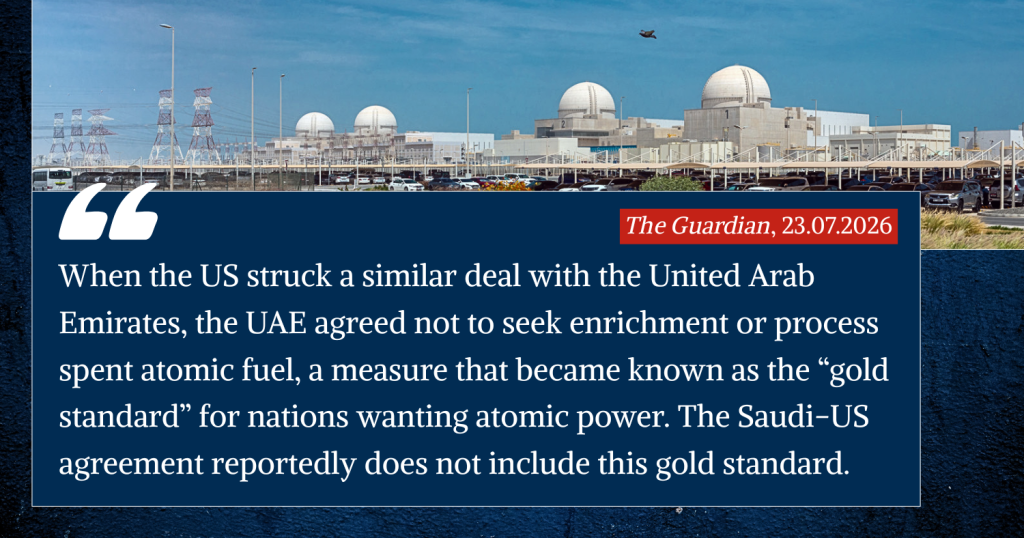
President Obama also signed a deal in 2009 that saw the transfer of nuclear technology, materials and know-how to the UAE. However, this was spun as a non-proliferation success as the deal was contingent on IAEA regulation and strict rules against domestic uranium enrichment. Neither of these stipulations appear to be part of the US-Saudi deal announced this week.
US involvement in proliferation, even if accidental, has an even longer history than this; the Indian nuclear enterprise was enabled by Eisenhower’s “Atoms for Peace” programme. The US supplied the heavy water for India’s first plutonium-producing CIRUS reactor, believing it would be used exclusively for ‘peaceful’ development of nuclear energy.
It turned out this was able to produce weapons-grade plutonium sufficient to build two atomic bombs per year. It was only a matter of time before domestic and geopolitical factors reversed the Indian government’s traditional opposition to nuclear weapons, and these technologies used to pursue nuclear explosive devices.
Whether Saudi Arabia seeks to pursue nuclear weapons remains to be seen. Crown prince bin Salman has stated willingness to pursue nuclear weapons if Iran did the same. A nuclear arms race of this kind is exactly the kind of scenario the Middle-East Treaty Organisation is aiming to prevent by pursuing a nuclear-weapons-free-zone in the Middle-East.
One of the things that the history of nuclear proliferation shows is the fundamental relation between nuclear energy and nuclear weapons. Those same technologies and materials which are promoted as peaceful or civilian can and do form the foundations of nuclear weapons programmes, once the political will to weaponise crystallises. This must be borne in mind when assessing the UK government’s insistence on spending exorbitant sums on new nuclear power stations, when other energy solutions would be better means of reaching climate goals.