

This week there have been interesting stories in the news about various aspects of the UK’s military capacity.
While not necessarily cause for either optimism or despair, these stories have provided an important insight into what be disarray in areas of the UK military.
On Wednesday, BBC security correspondent Frank Gardner wrote an extensive article about Britain’s capacity to wage war, citing informed sources concerned that Britain’s army could only fight for a matter of weeks.
This is despite the MoD already having the 6th largest military budget of any country in the world, with commitments by the government to virtually double it in the coming years.
It is also notable that the BBC article does not mention the words “nuclear” or “deterrence” even once.
This is a remarkable omission in such an analysis. It suggests that Gardner, and presumably senior military officials, are taking for granted scenarios that the UK’s exorbitantly expensive nuclear weapons can play no role in defending the country.

Of course, according to deterrence doctrine, Gardner and his sources’ ruminations about Britain’s military capacity are no cause for concern, since nuclear-armed states are never attacked.
But we know that “deterrence” is a largely a fantasy, since UK territory has been attacked in the past despite being a nuclear-armed power. And we must note that the ongoing discourse about the threat of hot war with Russia completely undermines the core premise of “deterrence” ideology – which is that nuclear weapons help keep the peace between major powers.
This BBC article follows news about the Ajax debacle, where a years-overdue armoured vehicle, designed by General Dynamics UK for the British Army at the cost of £5.5bn, was reported to be giving soldiers hearing damage.
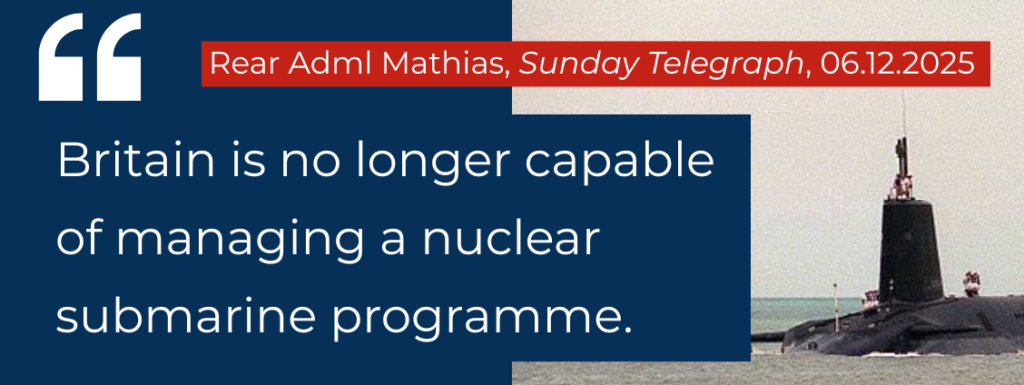
On top of this, last weekend a former Royal Navy Admiral was cited doubting that Britain’s nuclear submarine fleet was fit for purpose, so calamitous were the delays in construction, maintenance, retrofitting and decommissioning nuclear submarines. Stunningly, Rear Adm. Mathias also stated Britain should cancel its participation in the AUKUS multilateral submarine programme and that Dreadnought should be “the last class of nuclear submarine Britain builds”.
And what’s more – recent reports from Nuclear Education Trust and Nuclear Information Service suggest that the government’s plans to re-nuclearise the RAF are dramatically ill-conceived, probably breach the UK’s commitments under the nuclear Non-Proliferation Treaty and could generate another immense nuclear money-sink. All this simply to create a additional nuclear war system that is entirely under US control – given these jets would be carrying US-owned nuclear bombs.
Given the dreadful state of the submarine programme, there is some speculation in campaigning circles that the nuclear F35 plans are merely a face-saving exercise in case the Navy’s continuous-at-sea-deterrence mission stops being viable in the coming years.
It is hard to know what to make of all this, except to reasonably infer that there may be a crisis of competency within the UK military establishment and amongst many of its industrial partners.
From a disarmament perspective, it is hard to be glad that such immense sums of tax money are going to waste on both nuclear and militarism. At the same time, we should also never celebrate the successful production of abominable killing machines.
What matters is that we continue to build the movement opposing the nuclear menace, and especially challenging the dangerous and increasingly absurd notion that nuclear weapons keep us safe.
If widening sections of the defence establishment genuinely think Russia will confront Britain militarily in the coming years, then clearly they believe little in “deterrence” doctrine themselves. Perhaps we can capitalise on this.
With thanks for your continued support,
Scottish Campaign for Nuclear Disarmament
Samuel Rafanell-Williams
Campaigns and Communications Officer