
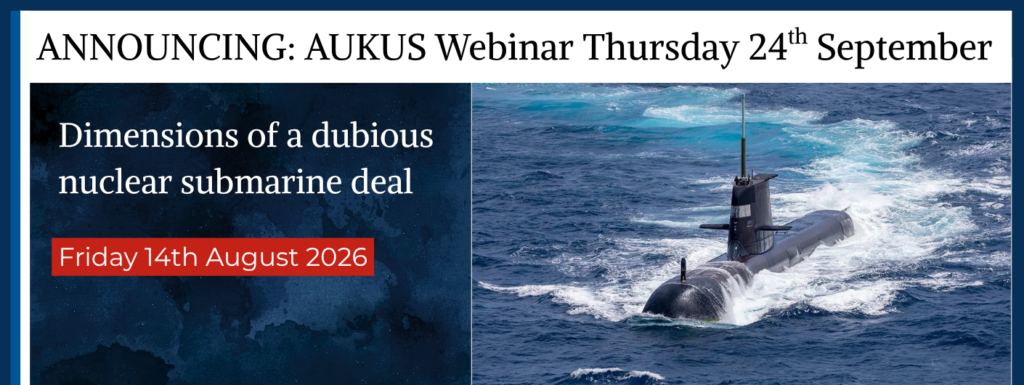
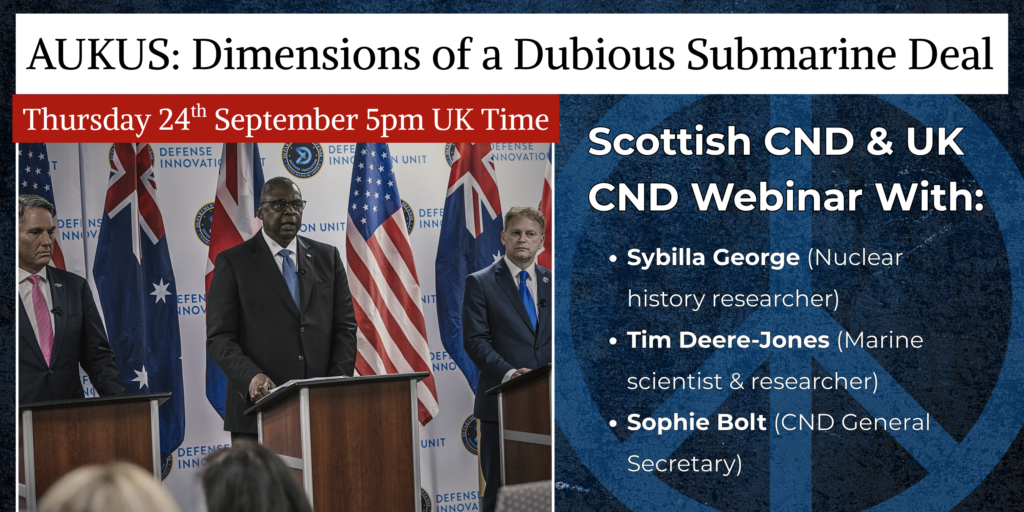
AUKUS: Dimensions of a Dubious Submarine Deal will be hosted by Scottish CND and UK CND. We invite two knowledgeable researchers to discuss the political contradictions, environmental impacts, proliferation risks and security concerns generated by this tripartite security deal in which the UK will play a major part. This free webinar will take place on Thursday 24th September at 5pm, UK time.
Sybilla George is a writer and emerging researcher from Melbourne who is soon to begin a Master’s degree at Sciences Po in Paris on nuclear history.
Tim Deere-Jones is a marine scientist and researcher who has been commissioned by Friends of the Earth Australia to write a comprehensive report on the environmental impacts and industrial problems within the UK’s submarine-building industry.
We will also hear from the General Secretary of UK CND Sophie Bolt, one of the leading figures in the British anti-war and anti-nuclear movement.

This summer has provided further evidence of the multiple intersecting national security threats posed by climate change. But after a national security meeting on Wednesday, rather than announcing nationalisation of water in England, or the recall of the British military’s only firefighting aircraft from Cyprus, the British Prime Minister told Brits to stay hydrated and announced he would urge shops not to sell disposable barbecues.
Intensifying extreme weather in the UK should serve as yet another reminder of the sheer uselessness of nuclear weapons against the genuine national security emergencies we face in the 21st century. Chief among these are the multiple interconnected threats posed by climate change and ecosystem collapse. But an intelligence report into these threats was suppressed by Kier Starmer’s government, while he and his successor continue to bestow tens of billions of pounds on BAE systems to build nuclear submarines.
Meanwhile, a high profile public inquiry is taking place across Australia into the AUKUS nuclear submarine deal between Australia, the US and UK. This inquiry, led by former Australian Environment Minister Peter Garrett, has highlighted considerable public and even elite dissent to the deal, which would see Australia provided with nuclear-powered submarines in exchange for hundreds of billions of dollars invested in the US and UK submarine industries.
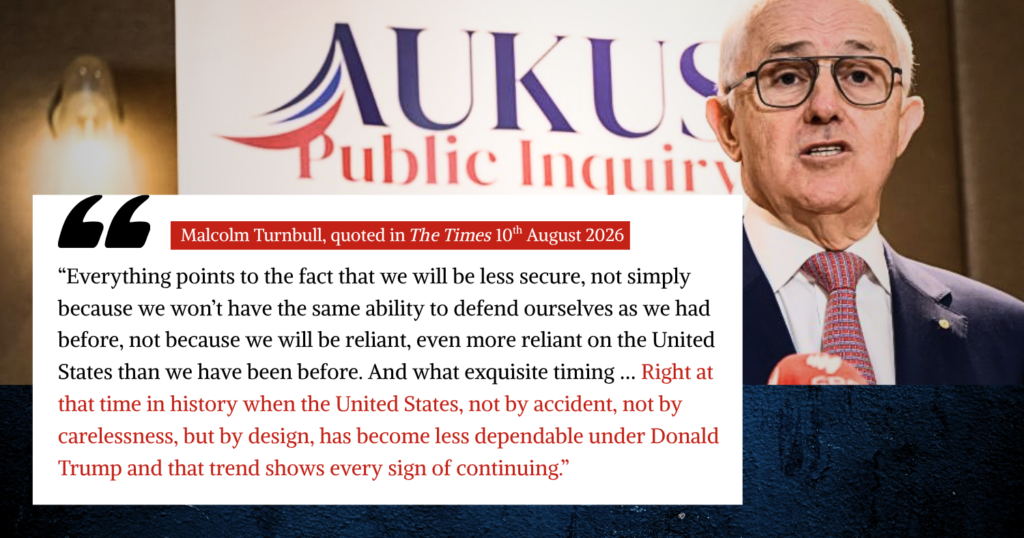
This week, former Prime Minister Malcolm Turnbull took the podium at the AUKUS inquiry to call the deal a “colossal mistake” and described Britain’s shipbuilding industry as “in disarray”. Former Australian Foreign Affairs Minister Gareth Evans has already said AUKUS could prove to be one of Australia’s “worst foreign policy decisions” and said believing that the US would defend Australia in the event of existential attack was a “ludicrous delusion”.
The Defence Investment Plan (p23.) announced by Kier Starmer just before his exit detailed that the UK would begin cutting steel for the SSN-A (AUKUS) submarines next year. Given that the final Astute attack submarine is still being built and there are chronic technical problems with the Dreadnought Trident-launching class, this could mean that BAE systems will be managing 3 different nuclear submarine programmes at once at some point in 2027. Meanwhile their submarine products have a questionable performance record: the Royal Navy’s BAE-built Astute attack submarines have been unavailable for deployment since early June due to extensive maintenance needs.
Our joint webinar with UK CND on Thursday 24th September, 5pm UK time will be an important opportunity to learn from informed sources on AUKUS, highlighting the international resistance to militarised nuclear technology we are also part of here in Scotland.