
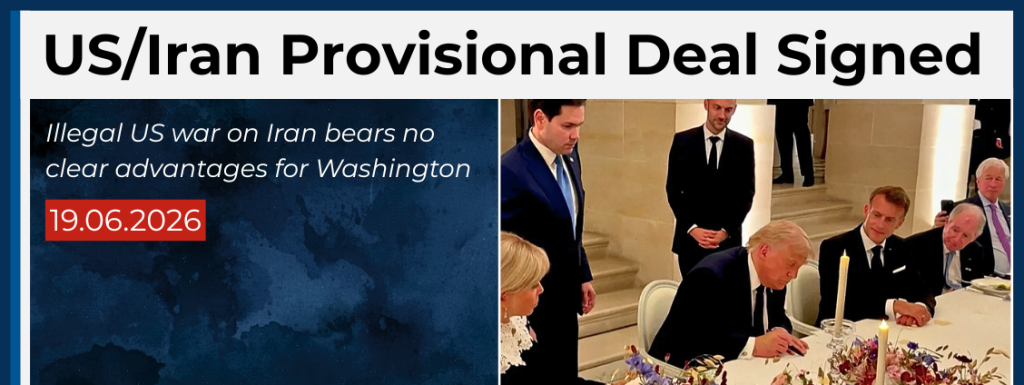
The great irony of the US President signing a provisional peace deal with Iran, or ‘memorandum of understanding’, at the palace of Versailles near Paris will not be lost on those who know their 20th century history.
The 1919 Treaty of Versailles formalised Germany’s defeat at the end of the First World War and enforced war reparations in favour of the European ‘Entente’ allies.
But 107 years on, which party occupied the role of Germany at this week’s peace deal at Versailles? As much as the US administration has promotes supposedly major military achievements (“destroying Iran’s navy”), it is the US that will facilitate reconstruction funds to Iran to the tune of $300bn, to pay for damages caused by this illegal war.
And moreover, the 14-point deal signed by Trump this week included working towards the lifting of US economic sanctions on Iran, including UNSC resolutions – the kind of concession it has been hard to envision any US President making. As well as the US immediately lifting their own naval blockade, Iran will also benefit from waivers on currently-restricted oil exports.
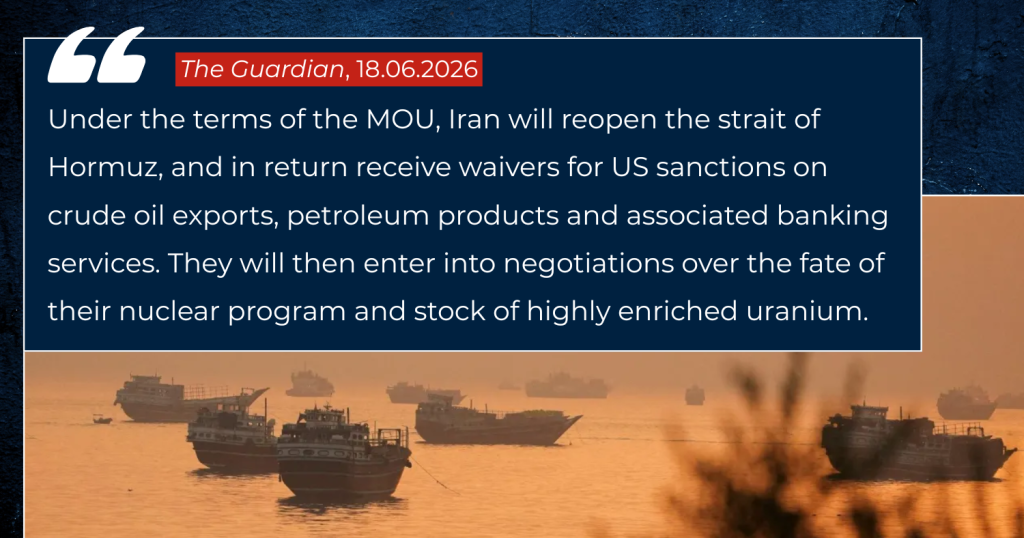
In return, Iran has agreed to reopen the Strait of Hormuz to allow commercial transit through this shipping lane which processes 20% of the world’s maritime oil trade.
Further, Iran has agreed to enter talks with the US on its nuclear programme in an ensuing 6-month negotiation period. This will reportedly involve discussing the disposal of its stockpile of highly-enriched uranium, possibly supervised by the International Atomic Energy Agency (IAEA).
It should be noted that the “concessions” offered by Iran on its nuclear programme were already effectively on the table in negotiations before the latest US/Israeli military attack starting in late February. And of course, the Strait of Hormuz was open and operating as standard before that attack.
So on balance, on top of causing thousands of deaths, and massive infrastructural and environmental damage across the region, it appears the US/Israeli attack on Iran has not borne any advantages for Washington’s “interests” that good-faith diplomacy could not have achieved.
In fact, Iran’s position is arguably strengthened compared to when they signed the 2015 JCPOA deal, which offered considerably less sanctions relief in exchange for strict IAEA monitoring of its nuclear programme.
But the main benefit of this deal to the US, Iran and the entire global community is the immediate cessation of hostilities and prevention of further military escalation. Irrespective of who “came out on top” as a consequence of the deal, this should be emphatically welcomed.
Overall, this disastrous war is further evidence that violent, military action does not secure strategic national interests in the way that war-hawks would like us to believe. Progress on contentious international affairs is far more effectively pursued though robust diplomatic processes. There are lessons to be learned from this debacle in our own country, where the military establishment are erroneously trying to promote re-armament and preparation for war with supposed adversaries as a way to maintain international security.
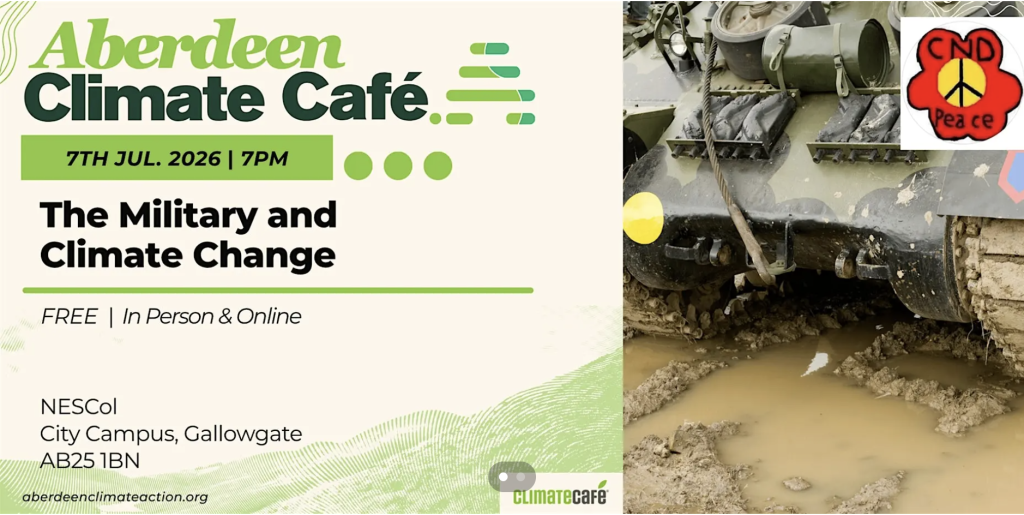
On this note, we would like to encourage all supporters to sign up free for an upcoming webinar hosted by CND North East Scotland and Aberdeen Climate Action. They will be hosting Kate Whitaker (Friends of the Earth Scotland) and Professor Stuart Parkinson (Scientists for Global Responsibility) to discuss the massive climate implications of militarism and war.