
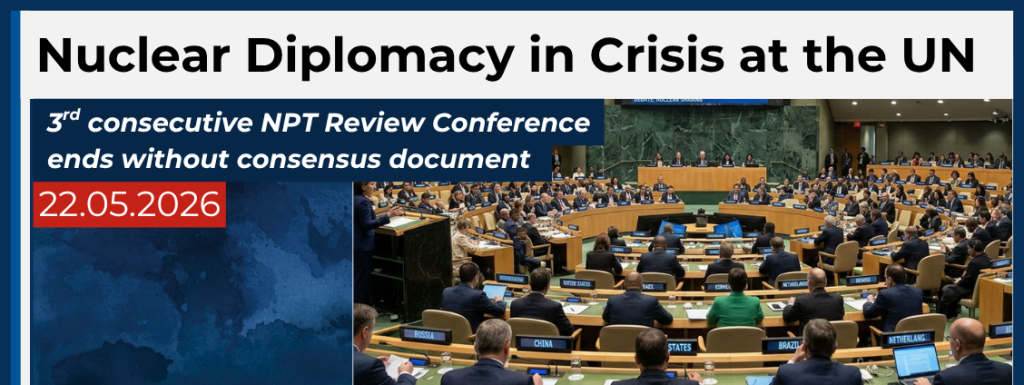
Last Friday, the 3rd consecutive Review Conference of the UN Nuclear Non-Proliferation Treaty ended without a consensus document, indicating a historic crisis in the world’s cornerstone nuclear treaty.
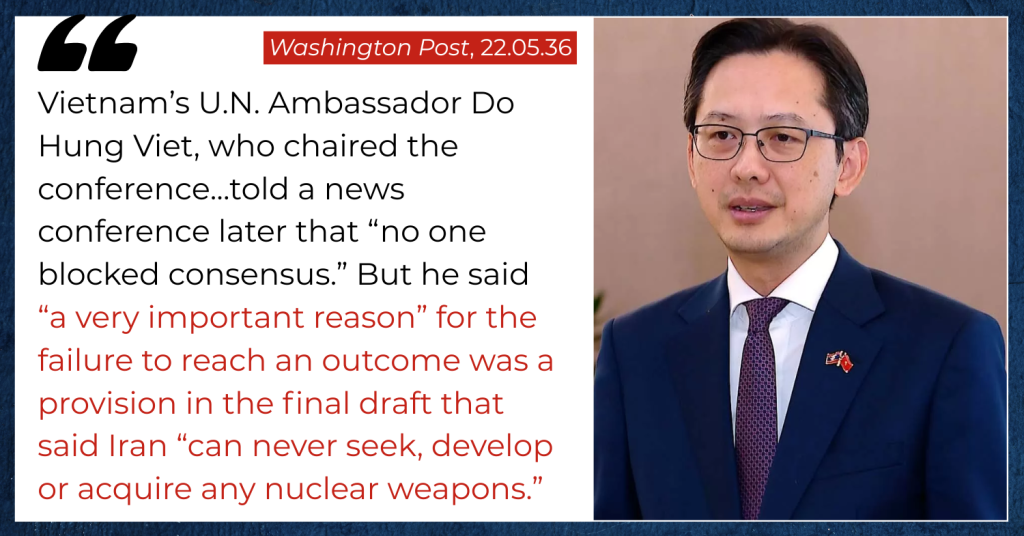
The conference chair, Vietnamese ambassador to the UN Do Hung Viet, said that a “very important reason” consensus had not been reached was the US’ insistence on adding an amendment stipulating that “Iran can never seek, develop or acquire any nuclear weapons.” This singling-out that created controversy amongst many delegations, not least because of the unprovoked war the US is currently waging against Iran.
This was not the only reason that consensus was spoiled, though. The core division between nuclear and non-nuclear armed states was repeatedly raised by delegations as the main obstacle to meaningful diplomatic progress, with the Malaysian delegation expressing concern that the nuclear states were lobbying to legitimise the indefinite possession of nuclear weapons, contrary to the treaty’s core aims and their own past commitments.
The final draft document apparently made no mention of nuclear threats, nuclear sharing or indeed the illegal acts of aggression committed by multiple nuclear-armed states over recent years. Provisions prohibiting nuclear testing and against risks of integrating AI into nuclear weapons systems were also absent.
Overall, the document was one in which the will of nuclear-armed states was expressed, and the concerns of non-nuclear-armed states were almost entirely neglected. The chair of the conference did not table the draft, to avoid accusations of blocking by any state and to prevent the broadening of already wide rifts within the international community on issues of nuclear diplomacy.
We are entering a period in which the approach of nuclear states has been to water down any diplomatic constraints on their emerging policies of vertical proliferation. In the case of the UK this has involved raising the cap on its nuclear warhead stockpile since 2021, and expanding capabilities by integrating nuclear-carrying F35A’s into the RAF.
The UN remains the most significant forum for peace, arms control and disarmament efforts, despite its weakening by the cynical efforts of the nuclear-armed states. But these diplomatic struggles point to the importance of civic movements within these countries that can change the conversation around and attitudes towards nuclear weapons amongst their populations. If the international community is struggling to hold nuclear states accountable, perhaps it falls to civic movements to do so.
In other news, we encourage our members to watch back our recent webinar on nuclear power, which is now available to view in full on YouTube. SCND were very pleased to welcome Linda Pentz Gunter, Pete Roche and Dylan Morgan, all of whom have spent decades studying and campaigning against nuclear power and in favour of a clean energy future.
The webinar covers a whole range of arguments why nuclear power is a dead-end in the era of climate change, especially in Scotland. Issues such as the opportunity costs of nuclear power, the problem of nuclear waste, the supposed puzzle of renewables “intermittency,” and the emerging solutions in long-term battery storage, are all covered in this excellent discussion.
The Scottish election produced the largest anti-nuclear cohort of MSPs in Holyrood since devolution. Clearly, there is currently no popular appetite for highly costly new nuclear power in Scotland, and polling by Survation before the election showed that Scots overwhelmingly supported a future powered by renewables instead of nuclear.
Our YouTube channel is a great resource with several full-length webinars, interviews and videos on Scottish CND’s core issues. We highly encourage our supporters to look through our channel for subjects that interest them!